golden ratio??
Friday, July 18, 2008
well i use it to trade but NEVER have i bothered to really do a research on it.
until now.
which i deeply regret cause its kinda disturbing.
why?i start seeing them everywhere. literally.
let me explain:
ok Fibonacci is actually the name of a very smart -and prolly very rich- mathematician.
(dont bother finding out if hes married cause hes already dead)
and in his book, called something something, he mentioned these numbers: 0,1,1,2,3,5,8,11,21,34,55....known as the fibonacci sequence, heres how you get them.
0+1 = 1
1+2 = 3
2+3 = 5
3+5 = 8
the intriguing thing abt these numbers are, that they can be used to explain the branching of trees, arrangement of leaves on a stem, the number of petals on a flower, the bumps on a pineapple, the incline of the egyptian pyramids and even the family tree of honey bees!!
my goodness.
for skeptics: "yeah right, proof it!" (copied from wiki)Fibonacci numbers also appear in the description of the reproduction of a population of idealized bees, according to the following rules: - If an egg is laid by an unmated female, it hatches a male.
- If, however, an egg was fertilized by a male, it hatches a female.
Thus, a male bee will always have one parent, and a female bee will have two.
If one traces the ancestry of any male bee (1 bee), he has 1 female parent (1 bee). This female had 2 parents, a male and a female (2 bees). The female had two parents, a male and a female, and the male had one female (3 bees). Those two females each had two parents, and the male had one (5 bees). This sequence of numbers of parents is the Fibonacci sequence.
and. by dividing the number of females by males you derive at the number, 1.618. and this holy number is also known as the golden ratio.
the reason its so scary is because this ratio is EVERYWHERE. try measuring yr shoulder to yr fingertips and divide it by the length from yr elbow to yr fingertips....
for ppl who understand pictures better than words:

now get that calculator of yrs, thats buried underneath tonnes of dust, out and calculate....
oh my god! (it may not be exactly, but its ard there)
of course, this ratio (and some other related ones) can be used to determine market movements by means of retracements and extensions.
and why is it called the golden ratio and not fibonacci ratio? i dont know man. haha. speaking of calculator, sng mui....er-hem! thank you.btw, you really dont want to search wiki for fibonacci unless you want to be bombarded by formulas like this: where
where  is the golden ratio
- or this:
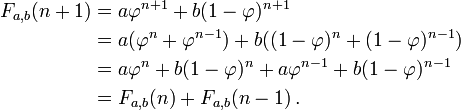
- or this:

wtf. i would die than be a mathematician man. honestly, what the hell is lim?!alright i know its limit.
=X but still.!okok. i need to go back to work.-bYe-
6:22 am
____________________

